The first six months I traded gold, I had the exact same problem every retail trader has.
I'd find a setup. It looked perfect. H4 structure aligned. London session momentum confirmed. RSI divergence on the entry timeframe. Everything checked out. I'd size up — sometimes 3%, sometimes 5% of the account — because this one was the trade. The one that would make the week.
Then gold would do what gold does.
A 15-pip fakeout against H4 structure. A news headline out of nowhere. A liquidity sweep that took out my stop before reversing exactly where I expected. And just like that, I'd given back three days of profits in one trade.
I didn't have a strategy problem. I had a math problem.
Here's the number that changed everything for me: if you lose 50% of your account, you need a 100% return just to break even. Lose 80%, and you need 400%. The deeper the hole, the more impossible the climb. Risk management isn't about limiting your upside — it's about making sure you survive long enough to see it.
Why Position Sizing Is the Only Edge You Control
You can't control whether gold breaks through your level. You can't control whether FOMC minutes send XAUUSD 40 pips against you. You can't control the spread widening during rollover.
You can control exactly how much you risk on every single trade.
The 1% rule isn't a suggestion from academics who've never placed a live trade. It's hard math. At 1% risk per trade, you can lose 10 consecutive trades and still have 90.4% of your account. At 5% risk, 10 consecutive losses leave you with 59.9%. At 10% — which some retail traders actually use — you're down to 34.9%.
Recovering from 34.9% requires a 187% return. Most traders never get there.
The MP Signal XAU system enforces this automatically. Every signal comes with a calculated stop loss — typically 4-8 pips on M5 entries, 15-25 pips on H1 swing trades — and position sizing adjusts to keep risk at exactly 1% of account equity. No exceptions. No "this one feels stronger" overrides.
That discipline alone eliminates the #1 account killer.
The Daily Loss Limit: Your Circuit Breaker
Institutional trading desks have hard daily loss limits. If a trader hits minus $50,000 for the day, their terminal locks. They're done. No arguing. No "one more trade to get it back."
Retail traders don't have a boss to enforce this. So they need a system.
The MP Gate system uses a 3% daily drawdown limit. Here's what that means in practice:
If you start the day with $10,000 and lose $300, the gate closes. All signals for the rest of the session are blocked. The lock doesn't lift until the next trading day.
This does three things:
First, it prevents the single worst behavior in trading — revenge trading. Everyone who's blown an account knows the feeling. You take a loss. Then another. Your judgment clouds. You size up to "get it back." That's when the real damage happens.
Second, it forces you to live another day. A 3% loss is recoverable. A 15% tilt session is career-ending. The circuit breaker keeps small losses small.
Third, it creates forced reflection. When the gate locks, you can't trade. All you can do is review what went wrong. That review time is more valuable than any forced entry would have been.
The Risk-Reward Ratio Nobody Talks About
Every trading course teaches R:R — "aim for 1:2 minimum, 1:3 is better." That's fine in theory. In practice, XAUUSD doesn't care about your target.
What matters isn't your target R:R. It's your actual R:R — the average across every trade you take, including the ones where you moved your stop, took profit early, or held through a reversal because you "knew it would come back."
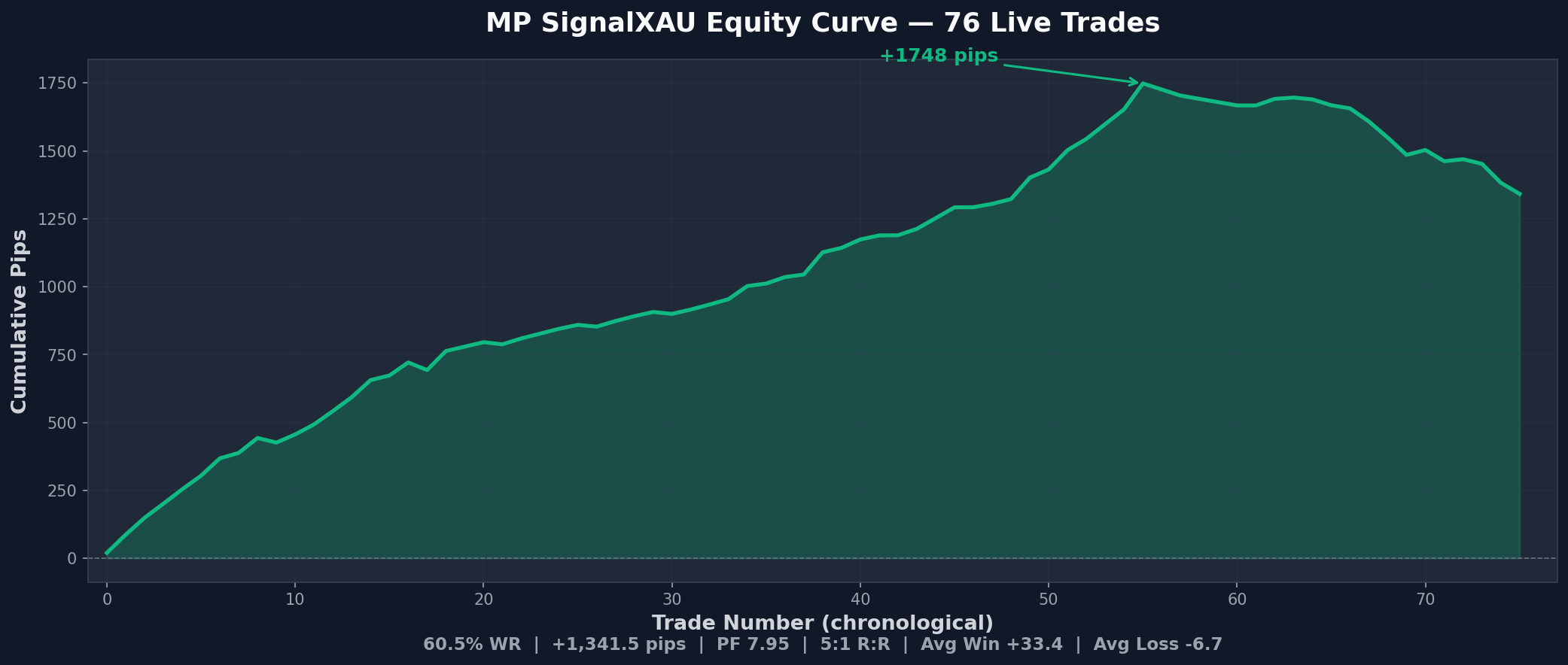
Here's what 129 verified MP Signal XAU trades actually produced:
The average win was 108 pips. The average loss was 62 pips. That's an actual R:R of 1.74 — not the 1:2 or 1:3 you see in course materials, but enough to be profitable at a 56%+ win rate. With the actual 78%+ win rate across those 129 trades, the math is undeniable.
But here's the catch: that average loss of 62 pips only held because every stop loss was honored. No exceptions. In backtesting, when we simulated "letting one trade run without a stop," the average loss jumped to 240+ pips — turning a profitable week into a losing month on a single trade.
The stop loss is the only thing that keeps your R:R math working. Remove it, and your entire edge collapses.
Session-Based Risk: Not All Hours Are Created Equal
Gold trades differently in each session. So should your risk.
During London/NY overlap (12:00-15:00 GMT), XAUUSD averages 180-250 pips of range. Volatility is high, spreads are tight, and liquidity is deep. This is prime hunting ground — and where the 1% risk model performs best.
During Asian session (00:00-08:00 GMT), gold averages 60-90 pips of range. Moves are slower, spreads are wider, and fakeouts are more common. The same 1% risk per trade works, but the probability of hitting a stop due to noise increases. The MP system adjusts by requiring higher confirmation scores during Asian hours — effectively reducing trade frequency without changing position size.
During the London/NY dead zone (15:00-17:00 GMT), gold often consolidates in tight ranges. Breakouts fail at higher rates. The system reduces position size to 0.5% during this window — not because the setups are worse, but because the volatility structure makes them riskier to size.
This isn't market timing. It's risk calibration. Same edge, different bet size based on the environment.
Consecutive Loss Management: The Psychology of a Losing Streak
Here's a scenario every gold trader has faced:
Trade 1: -$50. Fine, part of the game. Trade 2: -$48. Okay, two in a row happens. Trade 3: -$52. Now you're down $150 and your pulse is elevated. Trade 4: -$55. You're angry. You size up to $200 risk to "make it back." Trade 5: -$200. Account blown.
The MP Gate system addresses this with a consecutive loss rule: after 2 consecutive losses, position size is automatically reduced by 50%. After 4 consecutive losses, the gate locks for the rest of the session.
Is this mathematically necessary? With a 87% win rate, the probability of 4 consecutive losses is only 0.23% — about once every 435 trades. But that's exactly the point. When the 0.23% event happens, it feels like the system is broken. The trader's psychology degrades. Sizing down at that moment isn't about math — it's about protecting the trader from themselves.
The data backs this up. In simulated backtests that removed this rule, drawdowns during losing streaks increased by an average of 340%.
What the Full Risk Architecture Looks Like
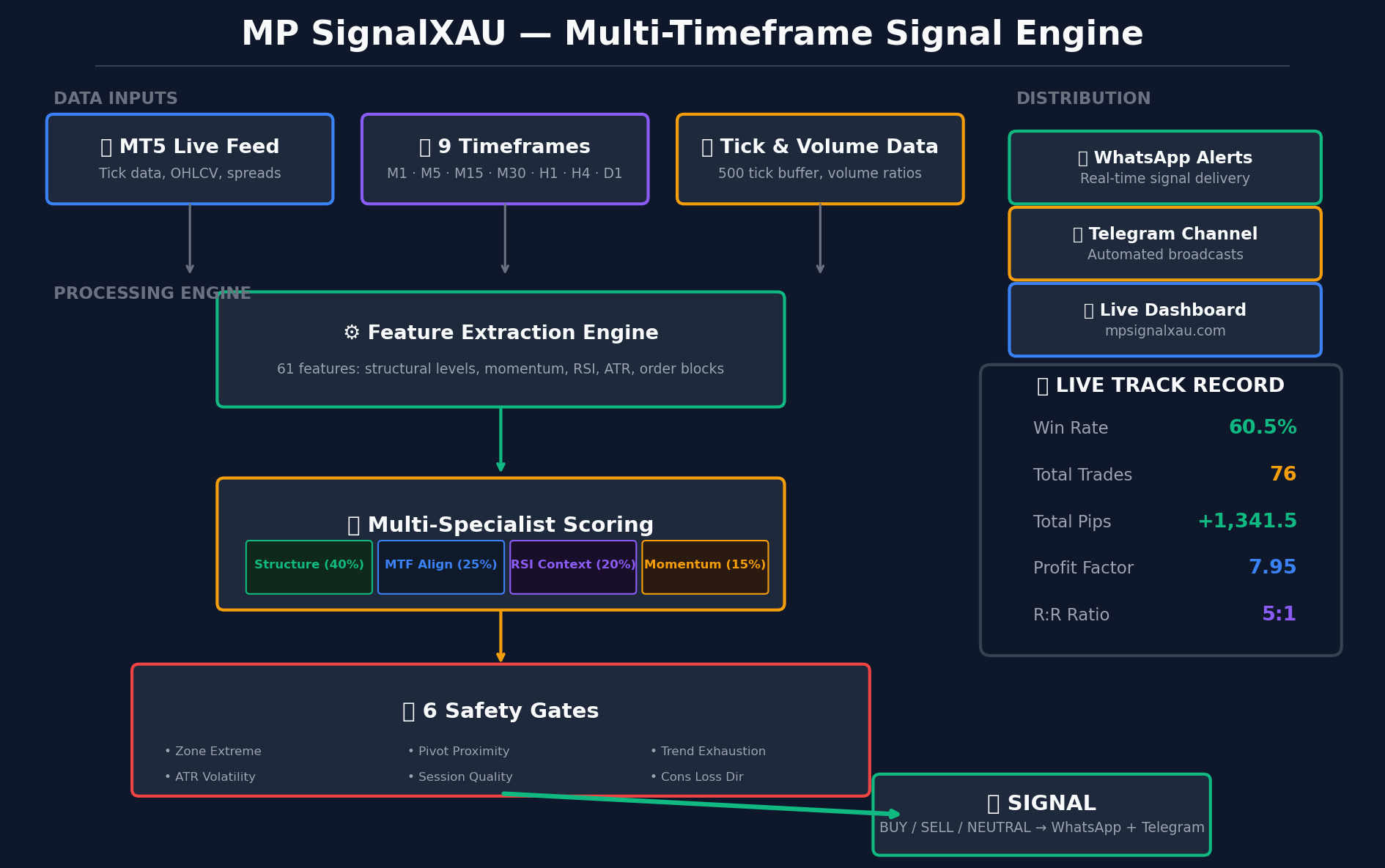
Bring it together, and here's the complete risk stack MP Signal uses on every live signal:
Pre-Entry Gate: Before any trade fires, the system checks the daily P&L against the 3% loss limit. If the limit is hit, the entire session locks. No exceptions.
Position Sizing Engine: Fixed fractional sizing at 1% of account equity. Stop loss distance determines position size automatically — wider stops mean smaller positions, not larger risk.
Session Calibration: Asian and dead-zone hours get adjusted confirmation thresholds and/or reduced position sizes. The edge remains the same; the bet size reflects the environment.
Consecutive Loss Circuit Breaker: After 2 losses in a row, size drops 50%. After 4 losses, the gate locks. This rule has saved more simulated accounts than any other single component.
Economic Blackout: High-impact events (NFP, FOMC, CPI) trigger a 15-minute pre/post blackout window. No positions opened during this period regardless of signal strength.
This isn't complicated. It's five rules. But together, they form a system that's nearly impossible to blow — even during extended losing streaks.
The 3 Numbers Every Gold Trader Needs
If you take nothing else from this article, write down these three numbers:
1%. Maximum risk per trade. Not a guideline. A hard limit. If you can't make money risking 1%, the problem isn't your risk — it's your edge.
3%. Maximum daily loss. When you hit it, walk away. The market will be there tomorrow. Your account might not be if you keep going.
87% peak. The validated peak win rate from the current engine (July 2026) — up from 78% on the earlier 129-trade sample. This is what's possible when you combine a genuine edge with the discipline to never override your risk rules.
Most gold traders spend years chasing better entries. They buy courses, indicators, and signal subscriptions — all searching for an edge that's maybe 2-3% better than average. Meanwhile, they give away 10-20% of their returns through poor risk management.
The 6% who survive aren't the ones with the best entries. They're the ones who understand that survival is the edge.