There's a reason the same exact trade setup works at 8:30 AM and blows up at 3 PM.
There's a reason gold feels "random" during certain hours and strangely predictable during others.
There's a reason institutional traders consistently extract profit during specific 2-hour windows while retail traders give it back during the rest of the day.
It's not luck. It's not a better strategy. It's timing.
And once you understand how gold behaves hour by hour, the market stops feeling aggressive and starts feeling *deliberate.*
Gold Is Not a 24-Hour Market (Even Though It Trades 24 Hours)
This is the first thing most traders get wrong.
Gold trades around the clock, Sunday evening through Friday afternoon. So new traders assume every hour is equal. Every candle is an opportunity. Every session is a chance to print money.
That assumption is what destroys accounts.
In reality, gold's trading day has three distinct phases — and only one of them is where you should be aggressively trading. The other two are for preparation and observation.
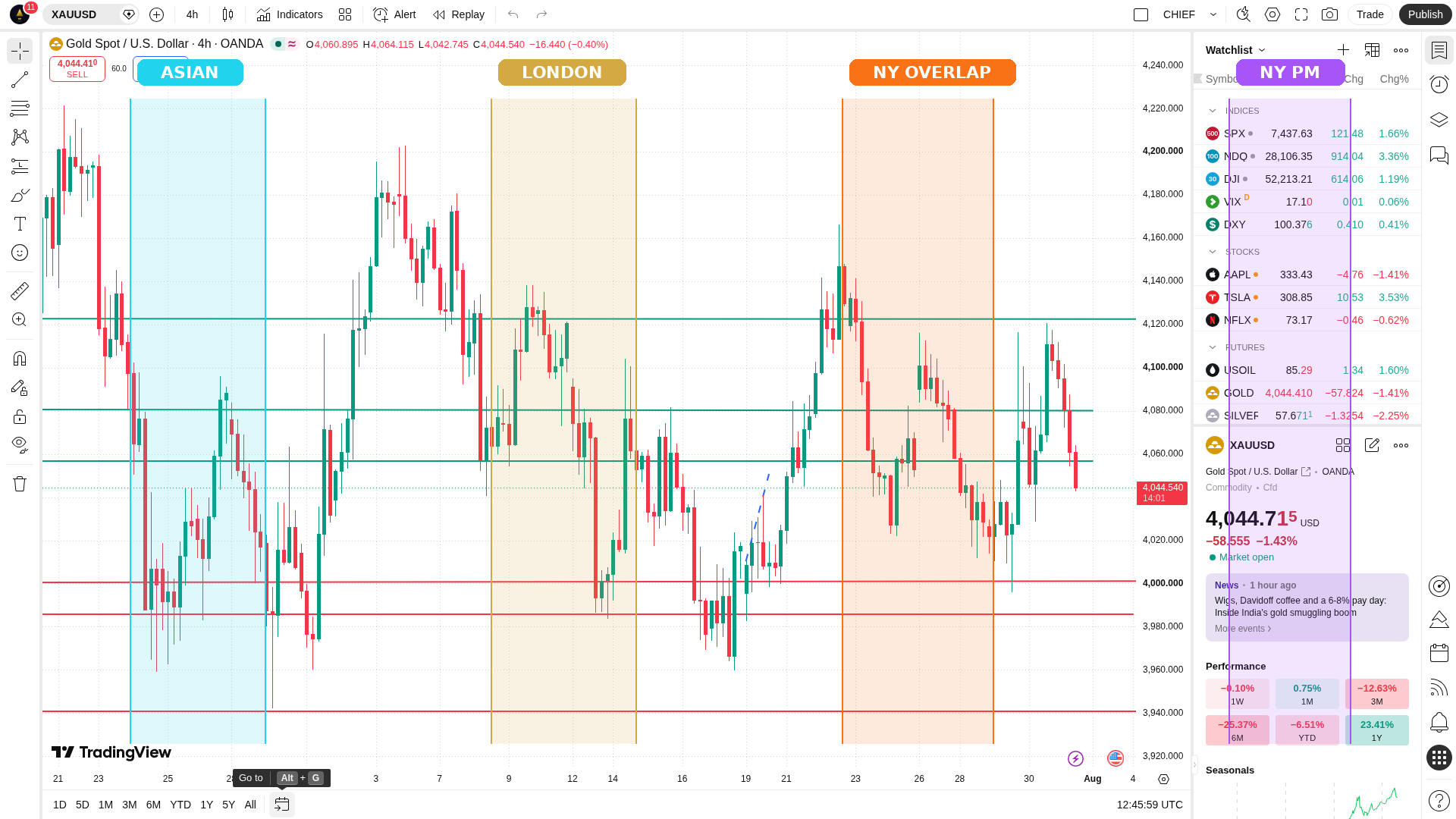
*The three major trading sessions and their characteristics. Notice the overlap zones.*
The Asian Session: The Setup (7 PM - 3 AM Eastern)
Most Western traders sleep through Asia. That's a mistake.
The Asian session is where the *narrative* for the day is written. Volume is lower, yes. But lower volume doesn't mean lower importance — it means *intentional* movement. Every tick during Asia happens for a reason, because there's not enough noise to hide behind.
During these hours, Asian central banks (China, Japan, India) execute their gold accumulation programs. Singapore and Hong Kong trading desks position for the European day ahead. Sovereign wealth funds adjust their precious metals exposure.
None of these players are scalping for 5 pips. They're executing multi-billion-dollar programs that take hours to fill. And they leave footprints.
What actually happens during Asia:
- Gold typically trades in a defined range (10-25 pips)
- The Asian session high and low become the day's most important reference points
- Equal highs or equal lows forming during Asia signal liquidity accumulation
- A slow grind higher on low volume = potential London reversal
- A tight consolidation range (<15 pips) often precedes an explosive London open
The most common Asian trap: A sudden 15-pip spike at 2 AM Eastern that breaks the range. New traders jump in thinking it's the start of a trend. It's almost always a liquidity grab — price returns to the range within minutes and then does the opposite.
The London Session: The Direction (3 AM - 12 PM Eastern)
This is where gold gets its *personality.*
When the European banks open their books — Deutsche Bank, UBS, Barclays, BNP Paribas — real volume enters the market. We're talking about orders measured in tons of physical gold, not lots. This is where Asia's quiet accumulation is either validated or violently rejected.
The London Open (3 AM - 5 AM Eastern): The most important 2-hour window in gold trading. Here's why:
- Asian range breaks during this window have the highest probability of continuation
- False breaks that immediately reverse are the second-most-common pattern (liquidity grabs)
- The direction established during London Open often holds through the New York session
- Volume profile confirms or denies Asia's narrative
The London Mid-Session (5 AM - 8 AM Eastern): This is the "grind zone." After the initial open, gold often enters a secondary consolidation. This is where European institutional desks are executing the bulk of their daily orders. The market feels choppy because it IS choppy — you're trading against algorithms designed to hide 100,000-ounce orders.
Trading during this window requires patience. The best setups are retests of the London open's structure, not new breakouts.
The London Close / Pre-NY (10 AM - 12 PM Eastern): European desks begin squaring positions. Volume tapers. This often produces counter-trend moves as European profits are taken. If gold has trended strongly during London, expect a pullback or consolidation during this window as the baton passes to New York.
The New York Session: The Release (8 AM - 5 PM Eastern)
New York is where London's preparation pays off. This isn't where direction is established — it's where liquidity is *harvested.*
The AM Kill Zone (8 AM - 11 AM Eastern): This is the single best trading window in gold. Period.
Why?
- London desks are still active (it's 1 PM - 4 PM in London)
- New York desks are fresh and fully staffed
- Both liquidity pools are at maximum depth
- Economic data releases are concentrated in this window
- Institutional algorithms run their highest-volume execution programs
During this overlap, gold moves are cleaner. Fakeouts decrease because there's enough liquidity to absorb them. Breakouts have higher follow-through. Retests are more reliable.
If you could only trade gold for 3 hours a day, this is the window.
The PM Session (12 PM - 5 PM Eastern): After London closes at 12 PM Eastern, the character of gold changes dramatically. Volume drops by 40-60%. Spreads widen. Moves become more erratic.
This is where the 94% give back what they made in the morning. They see gold moving and feel compelled to trade. They don't realize they're now swimming in a smaller pool with the same sharks.
The PM session is for:
- Managing existing positions (trailing stops)
- Preparing for the next day (marking levels)
- Reviewing and journaling
- NOT for initiating new trades (unless there's a FOMC or major data event)
How My System Adapts to Sessions
The MP signal engine isn't a static set of rules — it adjusts based on which session is active.
During Asia: The system requires tighter confirmation. Score thresholds increase. Position sizing is reduced. The goal is protection during lower-liquidity hours.
During London-NY Overlap: The system is most aggressive. Score thresholds relax slightly. Position sizing normalizes. This is where the majority of winning trades originate.
During NY PM: The system goes quiet. It's rare to see a signal after 12 PM Eastern because the safety gates — specifically Session Quality and Zone Extreme — become more restrictive when liquidity thins.
This isn't a flaw. It's by design. The system doesn't trade for the sake of trading. It trades when conditions are favorable and steps aside when they're not.
The Practical Daily Framework
Here's exactly how I structure my trading day. Steal this:
Pre-Asia (5 PM - 7 PM Eastern):
- Mark yesterday's swing highs and swing lows on H4 and H1
- Identify any untested order blocks from the previous day
- Note where liquidity is building (equal highs/lows from the prior session)
- This takes 10 minutes. Do it. The rest of the day flows from here.
During Asia (7 PM - 3 AM Eastern):
- The system monitors; you don't need to be awake
- Wake up and check: Did gold make a new Asian session high or low? Is the range wide or tight?
- If the range is tight (<15 pips), prepare for an explosive London open
London Open (3 AM - 5 AM Eastern):
- Watch whether gold breaks above or below the Asian range
- If it breaks and holds for 15 minutes: direction is likely set for the day
- If it breaks and immediately reverses within 5 minutes: it was a liquidity grab — fade it
London-NY Overlap (8 AM - 11 AM Eastern):
- Maximum opportunity window
- Look for pullbacks to London-established structure within this window
- These are the highest-probability entries of the entire day
- Execute confidently
Post-NY (12 PM Eastern):
- Trail stops on open positions
- Do NOT open new trades unless there's a scheduled catalyst
- Review the day. Journal every trade. Prepare tomorrow's levels.
One Chart That Explains Everything
I used to believe finding the perfect entry was the key to profitability. It's not.
The key is being in the right place at the right time with the right risk.
A mediocre entry at 8:45 AM Eastern with proper structure confirmation will outperform a "perfect" entry at 3 PM Eastern every single time. The market respects session timing far more than it respects your analysis.
The 94% trade whenever they see a pattern. The 6% wait for the pattern to appear at the right time.
One of those approaches works.
—-
→ Get session-aware gold signals: [mpsignalxau.com](https://mpsignalxau.com)
→ Full track record with timestamps: [mpsignalxau.com/performance.html](https://mpsignalxau.com/performance.html)