The Firm Everyone's Asking About
In the algorithmic trading community, prop firms are the holy grail. Pass a challenge, trade someone else's capital, keep 80-95% of the profits. No personal account to blow up. No margin calls. Just pure strategy execution at scale.
4PropTrader is one of the names that keeps coming up. Dubai-based. Six account tiers from $10,000 to $250,000. A flat 95% profit split — among the highest in the industry. No daily drawdown limit (only an end-of-day trailing drawdown). On the surface, it looks like an algorithmic trader's dream.
But I've learned to read the fine print. After auditing my own trading system's broker statement — discovering a $2,035 gap between my paper journal and reality — I apply the same skepticism to prop firms. The Terms of Service aren't marketing. They're the contract. And contracts with Dubai jurisdiction, subjective compliance standards, and no appeal process deserve scrutiny.
This article is that scrutiny. Every claim is sourced from 4PropTrader's published Terms of Service (as of August 2026), the FAQ/rules page, a Fortunly review documenting the payout structure, and community reports from TrustPilot, Reddit, and ForexPeaceArmy.
Reading the Fine Print So You Don't Have To
Most traders sign up for a prop firm challenge in under 10 minutes. They skim the marketing page, glance at the profit split, and enter their credit card. The Terms of Service — a 20+ page legal document — gets the "I agree" checkbox treatment.
That's the business model. Prop firms don't make money from profitable traders. They make money from challenge fees. The average trader fails the evaluation. The firms collect the fee. Rinse and repeat. The more traders who sign up, the more fees collected — regardless of how many actually get funded.
The Terms of Service are designed to protect the firm, not the trader. Every clause that seems restrictive, subjective, or unappealable is there because the firm learned — probably through expensive experience — that giving traders the benefit of the doubt costs money.
Here's what happens when you read 4PropTrader's Terms with an algorithmic trader's eyes.
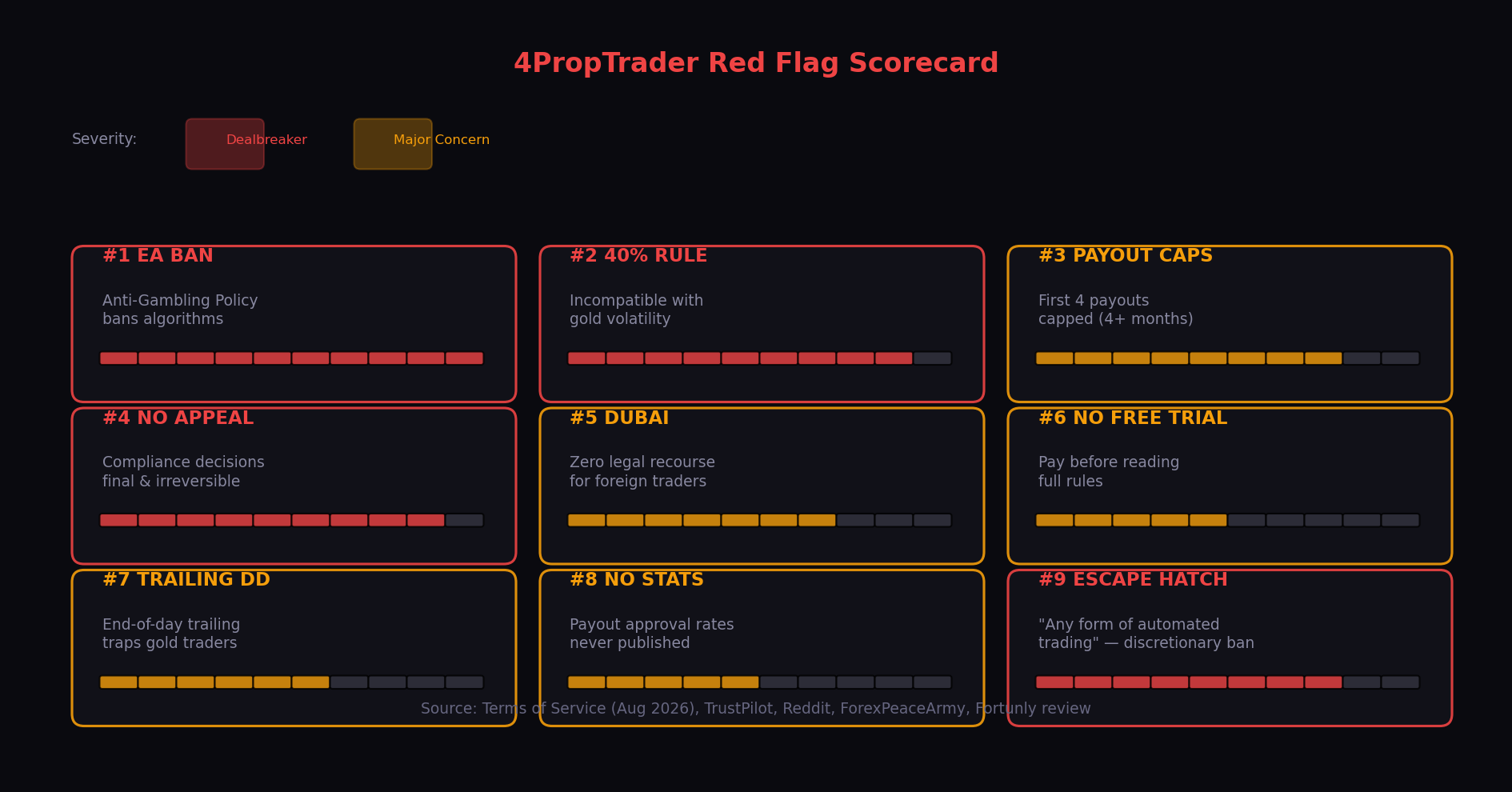
Figure 1: The 9 red flags identified in the 4PropTrader audit, ranked by severity for algorithmic gold traders. Flags 1 and 2 are dealbreakers on their own.
Red Flag #1— The Anti-Gambling Policy That Bans Your Algorithm
Expert Advisors and Automated Trading Are Explicitly Prohibited
Buried in the "Anti-Gambling Policy" section of the Terms of Service is language that prohibits trading strategies "executed by automated means without human oversight," including Expert Advisors, trading bots, and automated scripts. This is not a gray area. It's not "EAs allowed with disclosure." It's an explicit ban on the very thing algorithmic traders do. If you're running an MT5 EA, a Python-based trading bot, or any automated execution system — even one you built yourself — 4PropTrader's Terms classify it as prohibited "gambling-like behavior." The compliance decision is "final and irreversible" with no appeal.
This is the dealbreaker. Not the payout caps. Not the consistency rule. Not the jurisdiction. If you trade algorithmically, 4PropTrader reserves the right to void your challenge, cancel your funded account, and deny your payout — all because your trading method matches their definition of prohibited activity.
The irony is thick. Algorithmic trading is more disciplined than manual trading — no revenge trades, no FOMO entries, no 4:55 PM "get back to even" impulses. But prop firms aren't looking for discipline. They're looking for a narrow definition of "trader skill" that excludes automation because it's harder to monitor for abuse and harder to classify as "sustainable."
Red Flags #2–5: The Four Supporting Dealbreakers
40% Consistency Rule vs. Gold's Volatility
4PropTrader requires that no single trading day accounts for more than 40% of total profits. This is a common prop firm rule designed to prevent "one big trade and done" strategies. But gold regularly moves $50–$100 in a single session. A well-timed XAUUSD entry during a CPI release or FOMC statement can produce a week's worth of profit in 30 minutes. Under the 40% rule, that trade — even if perfectly executed — can disqualify you. The rule assumes markets move in predictable, evenly-distributed increments. Gold does not.
Payout Caps Lock You In for 4+ Months
The 95% profit split sounds great. But your first four approved payouts are capped based on account size: $900 (10K account), $1,500 (25K), $2,000 (50K), $2,500 (100K), $3,000 (150K), $4,000 (250K). Caps are only removed from the fifth approved payout onward. That means four successful payout cycles — potentially 4+ months of consistent trading — before you access the full 95% split. If you blow the account before payout #5 (as most traders do), the firm keeps the uncapped upside while you collected capped payouts. The math favors the house.
Subjective Compliance With Zero Appeal
Terms state that compliance decisions are "final and irreversible." There is no independent review. No third-party arbitration. No mechanism for appeal. If the compliance team decides your trading pattern looks "gambling-like" — a term they define and interpret — your account is gone. Your payout is denied. You have no recourse. This is not a partnership. This is a one-sided contract with a built-in kill switch that the firm controls entirely.
Dubai Jurisdiction — Zero Legal Recourse
4PropTrader is based in Dubai. For a trader in the US, Europe, Africa, or Asia, pursuing legal action in Dubai's court system is functionally impossible — the cost of litigation exceeds any potential recovery. The Terms of Service are the only protection you have, and they explicitly state the firm has final say. This jurisdiction choice isn't an accident. It's a business decision that eliminates the most basic consumer protection: the ability to sue.
What TrustPilot, Reddit, and ForexPeaceArmy Actually Say
The Terms of Service tell you what the firm can do. Community reports tell you what the firm actually does. I searched across three platforms for consistent patterns:
| Platform | Rating / Sentiment | Key Pattern |
|---|---|---|
| TrustPilot | ~2.8 / 5 | Mixed reviews. Positive ones cite customer support responsiveness. Negative ones describe payouts denied for rule violations the trader claims not to have committed. Pattern: "I followed all the rules but they found something." |
| ForexPeaceArmy | Multiple complaints | Most common complaint: "improperly rejected my payout due to non-compliance." Traders describe passing challenges, trading funded accounts profitably, requesting payouts, and receiving rejections citing rule violations they were never warned about during trading. |
| Warning posts | Direct quote: "Be careful: 4PropTrader does not pay after funded." Multiple threads echo the same pattern — challenge passed, funded account traded, payout requested, payout denied. The "non-compliance" reason is a catch-all. |
The pattern across all three platforms is consistent and structural, not anecdotal. Traders pass challenges. They trade funded accounts. They request payouts. They get denied for "non-compliance." The specific rule varies — consistency, gambling-like behavior, lot size deviation, "pattern of trading inconsistent with sustainable strategy." But the outcome is always the same: the firm keeps the challenge fee, the firm keeps the funded account profits, and the trader gets an email with no appeal path.
💡 The Business Model Inversion
A prop firm's stated business model is: "We fund profitable traders and share their profits." The community data suggests a secondary model: "We collect challenge fees from traders who won't pass, and compliance-deny payouts from those who do." When rejection is free and unchallengeable, the incentive is to reject. Every denied payout is pure profit.
Red Flags #6–9: The Operator Pattern
No Free Trial — Pay Before You Can Read the Full Terms
There is no free evaluation, no demo challenge, and the full trading platform rules are only accessible after signup. You're paying for the privilege of discovering whether your strategy is even allowed. For an algorithmic trader, this means potentially paying $50-$500+ to discover that your EA violates the Anti-Gambling Policy on page 23.
End-of-Day Trailing Drawdown Is a Trap for Gold Traders
4PropTrader uses an end-of-day trailing drawdown — meaning your maximum loss limit trails your account's peak equity as it grows. For gold traders, this is particularly dangerous: a $50 intraday gold swing can push you toward the trailing drawdown limit, reset it lower, and then a small retracement the next morning triggers a violation. Intraday trailing drawdowns (which update tick-by-tick) are brutal but fair. End-of-day trailing drawdowns create a gap between what you see during the session and what the system records at midnight.
No Published Audit or Payout Statistics
4PropTrader does not publicly disclose what percentage of funded traders receive payouts, what percentage of payout requests are approved, or what the average payout amount is. Firms like FTMO publish these statistics. The absence of this data from 4PropTrader is not neutral — it's information asymmetry. The firm knows exactly how many traders get paid. You don't.
"Any Form of Automated Trading" — The Corporate Escape Hatch
The broadest clause in the Terms states the firm may disqualify traders for "any form of automated, algorithmic, or high-frequency trading deemed inconsistent with the firm's risk parameters." The word "deemed" does all the heavy lifting. It doesn't matter if your algorithm is low-frequency, well-tested, and consistently profitable. If compliance deems it inconsistent — with no published criteria for consistency — you're disqualified. This is not a rule. It's a permission structure for rejecting any trade the firm doesn't like.
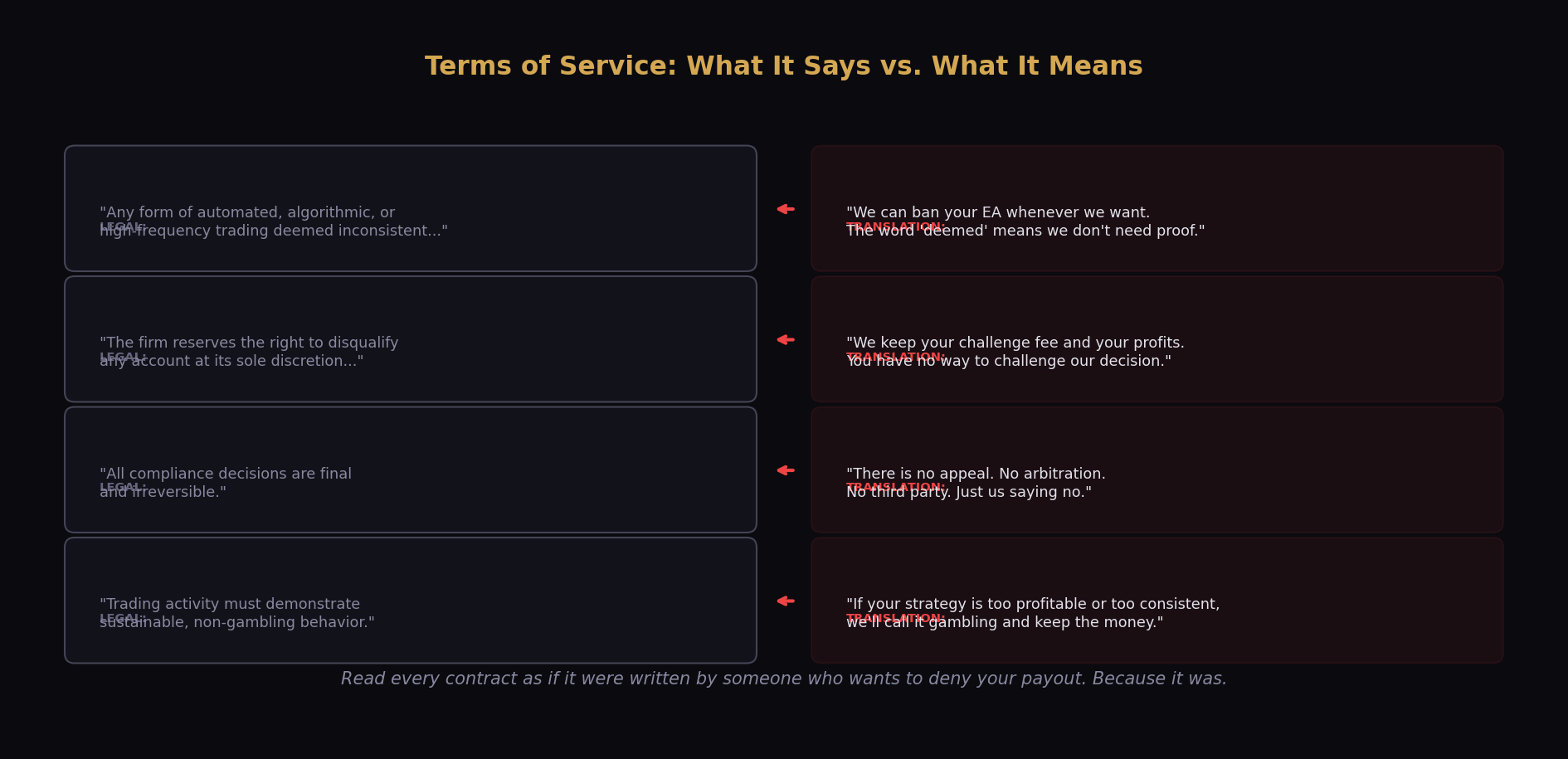
Figure 2: Four key Terms of Service clauses, translated from legal language to plain English. The gap between what's marketed and what's contracted is significant.
The Algorithmic Trader's Prop Firm Checklist
After this audit, I developed a framework for evaluating any prop firm before paying the challenge fee. Run every firm through these 8 questions:
- Does the firm explicitly allow Expert Advisors / automated trading? If the answer isn't an unambiguous "yes" in writing, assume it's a "no." "Allowed with disclosure" is acceptable. Silence is not.
- Are compliance decisions appealable? If the Terms say decisions are "final and irreversible," you have no protection. Even if you trade perfectly, the firm can deny you with zero cost.
- What is the jurisdiction? US, UK, or EU-based firms operate under enforceable consumer protection laws. Dubai, St. Lucia, Seychelles, or offshore jurisdictions offer no practical legal recourse.
- Does the consistency rule work for XAUUSD? Gold's daily volatility ranges from 0.5% to 3%. A 30-40% consistency cap forces you to either under-trade volatile sessions or over-trade quiet ones to balance the ratio.
- What are the payout caps? If the first 3-5 payouts are capped, calculate your realistic timeline to uncapped payouts. If it's 6+ months, the firm is betting you won't last that long.
- Does the firm publish payout statistics? Transparency about approval rates, average payouts, and funded trader retention is the strongest signal of a legitimate operation. Its absence is the strongest signal of the opposite.
- What is the trailing drawdown type? End-of-day trailing drawdowns create overnight gaps that can trigger violations you can't see coming. Intraday (tick-by-tick) trailing is more transparent but harder to survive.
- Can you test with a free trial? Any firm that won't let you demo their platform and rules before paying is betting that sunk cost will keep you in after you discover the restrictions.
Which Firms DO Allow Algorithmic Trading?
The good news: several prop firms explicitly welcome automated trading. Here's the landscape as of August 2026:
| Firm | Algo Policy | Platform | Notes |
|---|---|---|---|
| Phidias | ✅ Fully automated allowed | NinjaTrader, Rithmic | Most permissive — no manual oversight required. Clear algo-friendly rules. |
| Lucid Trading | ✅ EAs, bots, signals allowed | NinjaTrader, Tradovate | Clearest algo-friendly rule set among futures firms. Automated entries OK. |
| Tradeify | ✅ Fully automated allowed | NinjaTrader, Tradovate | Straightforward algo policy. No hidden restrictions on automation. |
| BluSky / Bulenox | ✅ EAs allowed | NinjaTrader, Rithmic | Allow automated entries via TradersPost, custom scripts, NinjaScript. |
| FundedNext | ✅ EAs allowed (forex) | MT4, MT5 | One of the few forex-focused firms with clear EA permission. MT5 compatible. |
| FTMO | ⚠️ Allowed with conditions | MT4, MT5, cTrader | Industry standard. Allows EAs but has restrictions on HFT, arbitrage, and tick scalping. Publish payout stats. |
| Take Profit Trader | ✅ Algo-friendly | NinjaTrader, Tradovate | Clean algo rules. No hidden automation restrictions. |
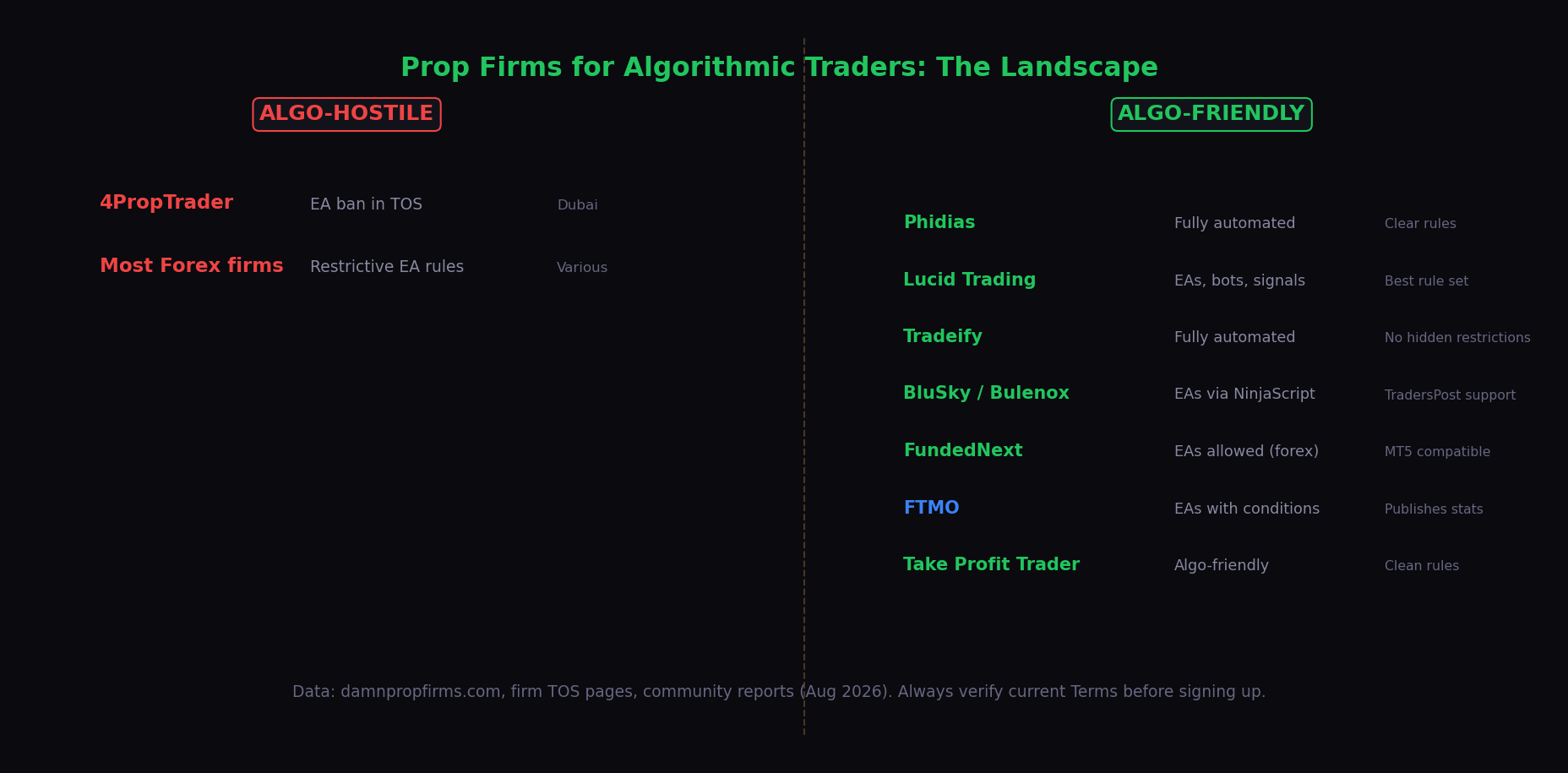
Figure 3: The algorithmic trading prop firm landscape. 7+ firms explicitly allow automation. The difference between "allowed with disclosure" and "prohibited by Anti-Gambling Policy" is the difference between getting funded and getting banned.
💡 Key Distinction: Futures vs. Forex Prop Firms
Most algo-friendly prop firms are in the futures space (NinjaTrader, Tradovate, Rithmic). The forex prop firm space (MT4/MT5) is more restrictive overall, with fewer firms explicitly permitting EAs. If algorithmic trading is your primary method, futures prop firms offer clearer rules, more algo-friendly policies, and better platform support for automation. FundedNext and FTMO are the notable forex exceptions.
The Real Cost of Getting It Wrong
Let's do the math on a worst-case 4PropTrader scenario for an algorithmic gold trader:
| Stage | Cost | What Happens |
|---|---|---|
| Challenge Fee | $50–$999 | You pay. You trade. Your algorithm — explicitly banned by the Terms — runs anyway. Maybe you pass. Maybe you don't. |
| Funded Account | Time (1–3 months) | You trade the funded account. You're profitable. You hit the 40% consistency rule one week because gold moved $80 in a session. Or compliance flags your EA. |
| Payout Request | $0–$4,000 denied | Your payout is denied for "non-compliance with Anti-Gambling Policy." The decision is "final and irreversible." Your appeal goes nowhere. |
| Total Loss | Challenge fee + time + denied profits | You paid to discover that the firm never intended to pay your algorithm. The Terms told you this on page 23. You just didn't read them. |
Compare this to signing up with one of the algo-friendly firms: you pay a similar challenge fee, you trade your algorithm, the firm knows you're using automation and has explicitly permitted it, and if you're profitable and within their published rules, you get paid. The challenge fee is the same. The outcome is different because the contract is different.
🔴 VERDICT: SKIP 4PROPTRADER
For algorithmic traders, 4PropTrader is not a viable option. The Anti-Gambling Policy explicitly bans the tools you use. The compliance process is subjective and unappealable. The jurisdiction offers no legal protection. The payout caps mean even if you survive all of the above, you won't access full profits for 4+ months. There are better options that want your algorithm, not ones that ban it.
What I'd Tell a Friend Asking About 4PropTrader
If you came to me tomorrow and said "I'm thinking about doing a 4PropTrader challenge with my gold trading algorithm," here's exactly what I'd say:
"Don't. Not because your algorithm won't pass the challenge — it probably would. But because the Terms of Service are not written for you. They're written to give the firm maximum discretion to deny your payout after you've done the work. The Anti-Gambling Policy explicitly bans automated trading. The compliance process has no appeal. The payout caps mean you're locked in for 4+ months even if everything goes perfectly. And if something goes wrong — which it will, because the contract is designed to catch you — you're in Dubai's legal system with zero practical recourse. There are firms that explicitly permit algorithmic trading. Use one of those. The challenge fee is the same. The contract is the difference between getting paid and getting an email."
Build a System, Not a Challenge Entry
There's a deeper lesson here that extends beyond prop firms. The entire structure of the prop trading industry — challenge fees, evaluation phases, compliance rules, payout caps — is designed around the assumption that most traders will fail. The business model works because failure is the default outcome.
Algorithmic trading challenges that assumption. A well-built algorithm doesn't revenge trade. It doesn't chase FOMO. It doesn't panic during drawdowns or get greedy near profit targets. An algorithm threatens the prop firm business model because it might actually be consistently profitable — which is exactly what the Terms of Service are designed to prevent.
This is why the Anti-Gambling Policy exists. It's not about gambling. It's about control. Manual traders are easier to disqualify on subjective "consistency" grounds because their trading is inherently variable. Algorithms are harder to disqualify because they follow rules — which is why the Terms need an explicit ban.
💡 The Meta-Lesson
Read every contract as if it were written by someone who wants to deny your payout. Because it was. The Terms of Service are not neutral documents. They're offensive weapons designed to protect the firm from having to pay profitable traders. If a clause can be interpreted against you, it will be. If a decision can't be appealed, it won't be reversed. If a jurisdiction is inconvenient for you to sue in, that's not an accident — it's the point.
Your algorithm is ready. Your strategy is tested. Your risk management is solid. Don't let a bad contract be the reason you don't get paid. Choose a firm that's written for traders like you — not one that banned you before you even signed up.