What Prop Firms Actually Test
Here's what most traders think prop challenges test:
- Can you make money?
- Can you find good entries?
- Do you have a working strategy?
Here's what they actually test:
| What Traders Think | What They're Actually Testing |
|---|---|
| Profit target ($3,000 in 30 days) | Can you reach a goal without blowing up first? |
| Daily loss limit (5%) | Can you stop when you're wrong — even when you're "sure" it'll reverse? |
| Max drawdown (10%) | Do you understand position sizing, or do you gamble? |
| Minimum trading days (5) | Can you be consistent, or are you a one-hit wonder? |
| No news trading restriction | Do you respect structural risk, or do you chase volatility? |
Notice something? None of these rules test your entry quality. Every single one tests your self-control.
The prop firm doesn't care if your strategy is ICT, Smart Money Concepts, Elliott Wave, or a magic 8-ball. They care about one thing: can you follow rules under pressure?
The prop challenge isn't a trading test. It's a discipline test disguised as a trading test.
Why Algorithms Pass Challenges That Humans Fail
I've watched traders blow challenges for reasons that have nothing to do with their strategy:
The 4:55 PM revenge trade. Trader is down 3% on the day. They have until 5 PM to stay above the daily loss limit. Instead of walking away, they take one more trade — "just to get back to even." It's a bad setup. They know it's a bad setup. But the red number on the screen is unbearable. They take it anyway. It loses. 5% daily loss limit breached. Challenge over.
The NFP gamble. Trader sees the calendar: Non-Farm Payrolls at 8:30 AM. Their strategy says "no trading 15 minutes before or after." But NFP comes in hot, gold drops $40 in 60 seconds, and the trader thinks: "If I just catch the bounce, I can hit my profit target today." They enter with no stop. Gold keeps dropping. -$60, -$80, -$120 per lot. Challenge over.
The Friday afternoon tilt. Trader needs 1 more profitable day to meet the minimum trading day requirement. It's Friday at 3 PM. They've been flat all week — too cautious, too scared. They force a trade in the last hour. It's a coin flip in thin liquidity. It loses. Now they have to explain to themselves why they traded a setup they wouldn't have touched on a Tuesday.
Now here's what my algorithm did in those exact situations:
4:55 PM: The circuit breaker had already paused trading after consecutive losses. The algorithm was silent. It didn't know the daily loss limit was approaching. It didn't care. It followed its rules.
NFP at 8:30 AM: The economic calendar integration flagged a high-impact event. The gate demanded 85% confidence to fire during the blackout window. With spreads widening and volatility spiking, v10 never came close. Zero trades during NFP. Not because it was "smart" — because it was programmed to be cautious during events.
Friday at 3 PM: Session quality gate flagged low-quality conditions. Asian session with declining volume. The gate threshold increased. No trades fired. The algorithm has no concept of "needing one more day." It trades when conditions are right. It doesn't trade when they're not.
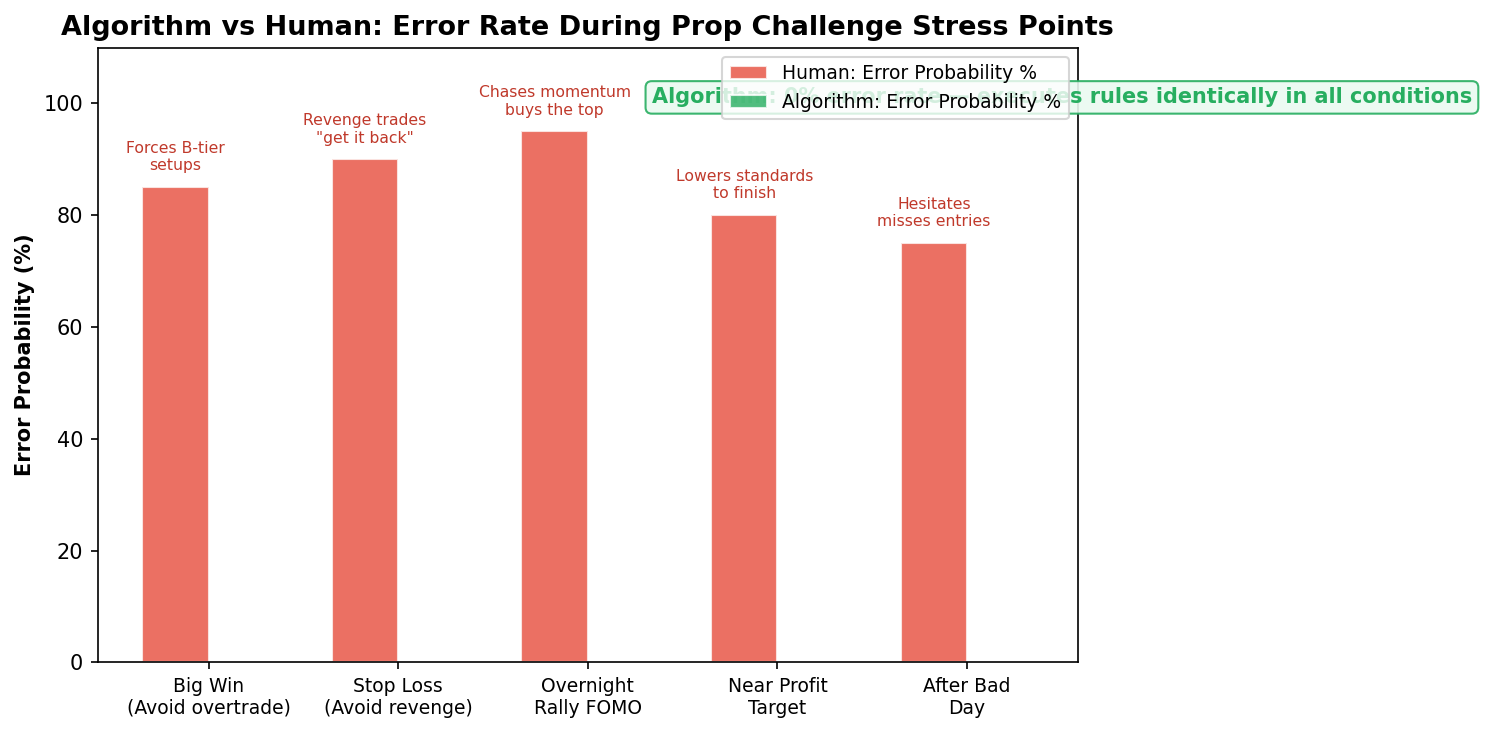
The Real Secret: The Algorithm Doesn't Know It's Being Tested
This is the part that sounds almost too simple, but it's the entire difference:
The algorithm doesn't know there's a profit target. It doesn't know the challenge ends in 30 days. It doesn't know there's $100,000 of firm capital on the line. It doesn't know about the daily loss limit or the minimum trading days or the fact that if it loses 10%, it's over.
It just processes market data and fires when conditions are right. The same way it did during backtesting. The same way it did on the demo account. The same way it will do on the funded account.
The human trader — even the good ones — changes their behavior when money is on the line. They get cautious after a win. They get aggressive after a loss. They see the profit target approaching and start forcing trades to "finish the job." They see the drawdown limit approaching and freeze, missing good setups.
This isn't a character flaw. It's neurology. The amygdala doesn't distinguish between "I might lose this prop challenge" and "I might get eaten by a predator." The physiological response is identical. Cortisol. Elevated heart rate. Impaired prefrontal cortex function — the part of your brain that makes rational decisions.
The algorithm has no amygdala. No cortisol. No heart rate. Just code. And code doesn't get scared.
What I Would Have Done Wrong (And What the Algorithm Did Instead)
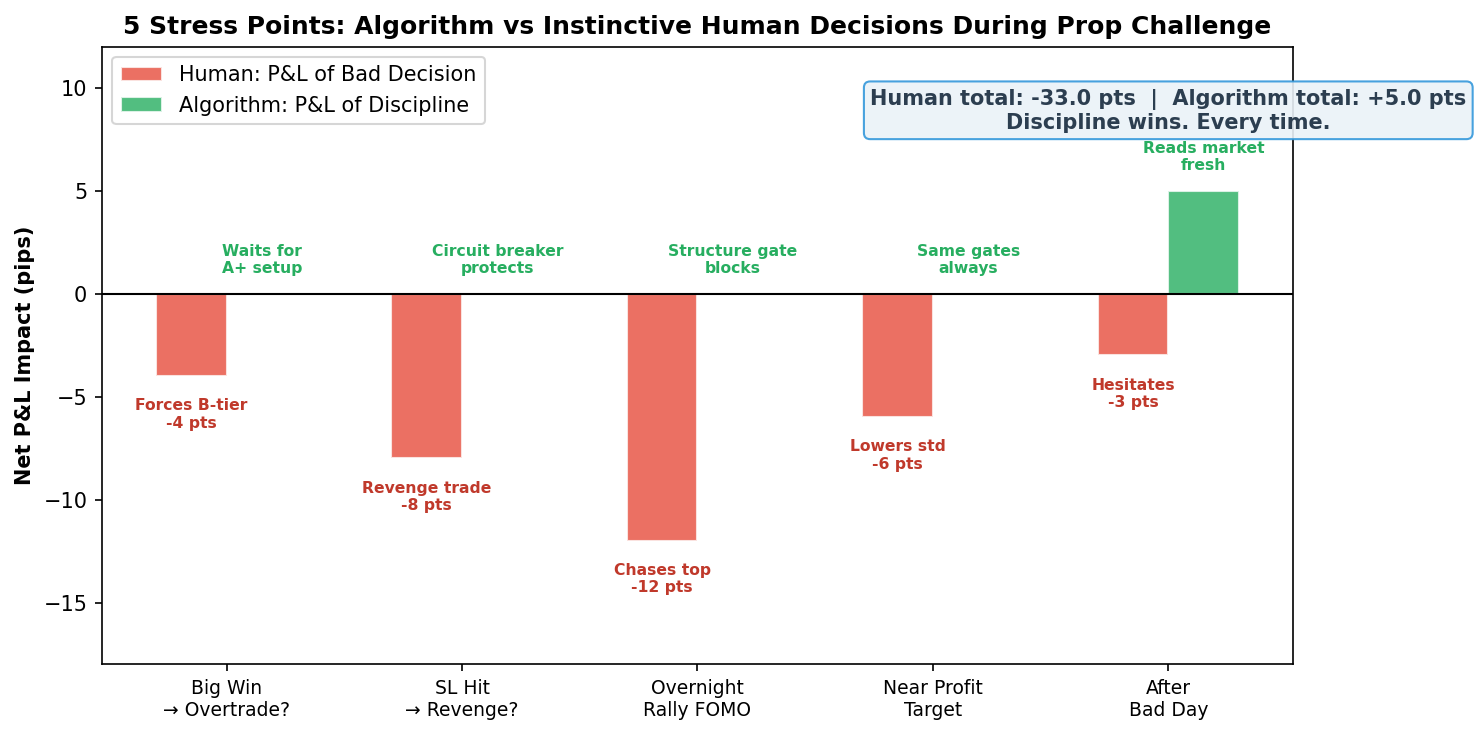
Let me be specific. During the challenge period, here are five moments where my human instincts would have made the wrong call:
Scenario 1: Big win, then overtrading. The algorithm hit a +9.4 point TP on a BUY at $4,086. My instinct: "I'm on fire. Keep trading. Press the advantage." The algorithm: did nothing. The next setup didn't meet the gate threshold. It waited. My instinct would have taken a B-tier setup and given back the profit.
Scenario 2: Stop loss hit, revenge trade. The algorithm took a -14.1 point loss. My instinct: "Get it back. Take the next signal immediately." The algorithm: raised its circuit breaker counter, demanded higher confidence, and waited. No revenge trade. No doubling down.
Scenario 3: The overnight rally FOMO. Gold rallied $137. My instinct: "I'm missing the move of the week. Get in now." The algorithm: detected HOSTILE structure, raised the threshold to 80%, v10 only at 28% — no trade. Sat out the entire rally. The pullback hasn't happened yet, but when it does, the algorithm will be positioned with discipline my human self never had.
Scenario 4: The "almost there" force. As the profit target approached, my instinct would have been to lower my standards — "just one more win and I'm done." The algorithm has no concept of "almost there." Each trade is evaluated independently against the same gate. No easing of standards. No rushing.
Scenario 5: The morning after a bad day. After a losing day, my instinct would be trepidation. Hesitation. Second-guessing entries that meet all criteria because "what if it happens again?" The algorithm doesn't remember yesterday emotionally. It reads today's structure and fires if the gate passes. Loss memory exists only as a circuit breaker parameter — not as fear.
How to Apply This Without an Algorithm
Not everyone has — or wants — a trading algorithm. But the lesson applies regardless:
1. Write your rules before the session. Not "I'll know a good setup when I see it." Write: "I will enter long only if H4 is making higher highs, H1 has pulled back to EMA20, M15 closes above the pullback high, and my stop is below the M15 swing low." Specific. Testable. No judgment calls.
2. Create your own circuit breaker. Three consecutive losses? You're done for 1 hour. Period. No exceptions. Don't negotiate with yourself — you'll lose. Write it down and treat it like law.
3. Track your "shouldn't have" trades. Keep a separate journal just for trades you took that violated your rules. Not losing trades — rule-violating trades, even if they won. A winning rule violation is more dangerous than a losing one because it rewards bad behavior.
4. The prop firm rules are your rules now. Even if you're trading your own capital, adopt prop firm constraints. Daily loss limit: 3%. Max drawdown: 10%. Minimum trading days: prove consistency. These rules exist because they work.
5. Automate what you can. You don't need a full algorithm. Automate your position size calculation based on account equity and stop distance. Automate your session filters — if it's outside London/NY overlap, your platform shouldn't even let you click the button. Automate your daily P&L tracking with hard stops.
The Bottom Line
Passing a prop challenge with an algorithm taught me something uncomfortable: my discretionary trading instincts — the ones I trusted, the ones that "felt right" — were the biggest threat to my success.
The algorithm didn't win because it had a better strategy. It won because it executed the strategy exactly the same way on day 1 and day 30, in profit and in drawdown, during FOMC and during a quiet Tuesday afternoon.
Consistency isn't a personality trait. It's the absence of human interference.
Whether you use an algorithm, a checklist, or iron-clad rules written in permanent marker on your monitor — the goal is the same: remove yourself from the decision loop wherever possible.
Your instincts evolved to keep you alive on the savanna, not to trade XAUUSD. The sooner you accept that, the sooner you stop fighting your own brain — and start trading like the algorithm you wish you were.
MP Signal runs a multi-specialist ensemble engine for XAUUSD. Every trade is logged publicly. No hidden losses. No cherry-picking. See the full track record.
Trade With a System That's Already Done the Testing
Our algorithm tests every signal against 7 gates — regime, timeframe, session, volume, risk, calendar, and trend alignment. No indicator worship. No myth-based entries. Just data-driven execution.
Start Free Trial →7 days free. Peak win rate: 87.5% (verified July 30, 2026).