The Trade That Shouldn't Have Fired
August 7, 2026. 10:15 AM ET. Gold is at $4,356.82.
My OMNI v10 algorithm fires a BUY signal. The v5 gate says BUY with a score of 6.5 — not quite the 7.0 threshold, but close. The v10 confidence score hits 78%. The structure analysis runs. It correctly identifies that gold is at the 92nd percentile of the H4 range. H1 RSI is reading 78 — deep overbought territory. Every instinct says this is a dangerous entry.
The gate passes it anyway.
Entry: $4,356.82. Stop loss: $4,340.22. Gold reverses within minutes. The stop loss gets hit. -16.6 points. Full loss.
This trade broke something in me. Not because of the money — $16.60 per lot isn't catastrophic. It broke something because the system knew better. The structure analyzer correctly identified HOSTILE conditions. The data was all there. And the gate ignored it.
When your system has the right data and makes the wrong decision, you don't have a strategy problem. You have an architecture problem.
The Autopsy: Three Failures, One Root Cause
I traced every line of code that touched this trade. The failures weren't bugs — they were design decisions that looked reasonable in isolation but created fatal gaps when combined.
| Failure | What It Did | Why It Failed | Real Impact |
|---|---|---|---|
| 1. H4 Zone Penalty | Penalized BUY at TOP with -0.5 score | -0.5 is negligible. Net score still kept structure at NEUTRAL instead of HOSTILE. | Gate threshold stayed at 75% instead of rising to 80% |
| 2. RSI Blind Spot | Only checked M5 and M15 RSI for trap conditions | H1 RSI at 78 was completely invisible. The big-picture overbought signal never reached the gate. | No penalty applied for hourly overbought — $4,356 was treated like any other price |
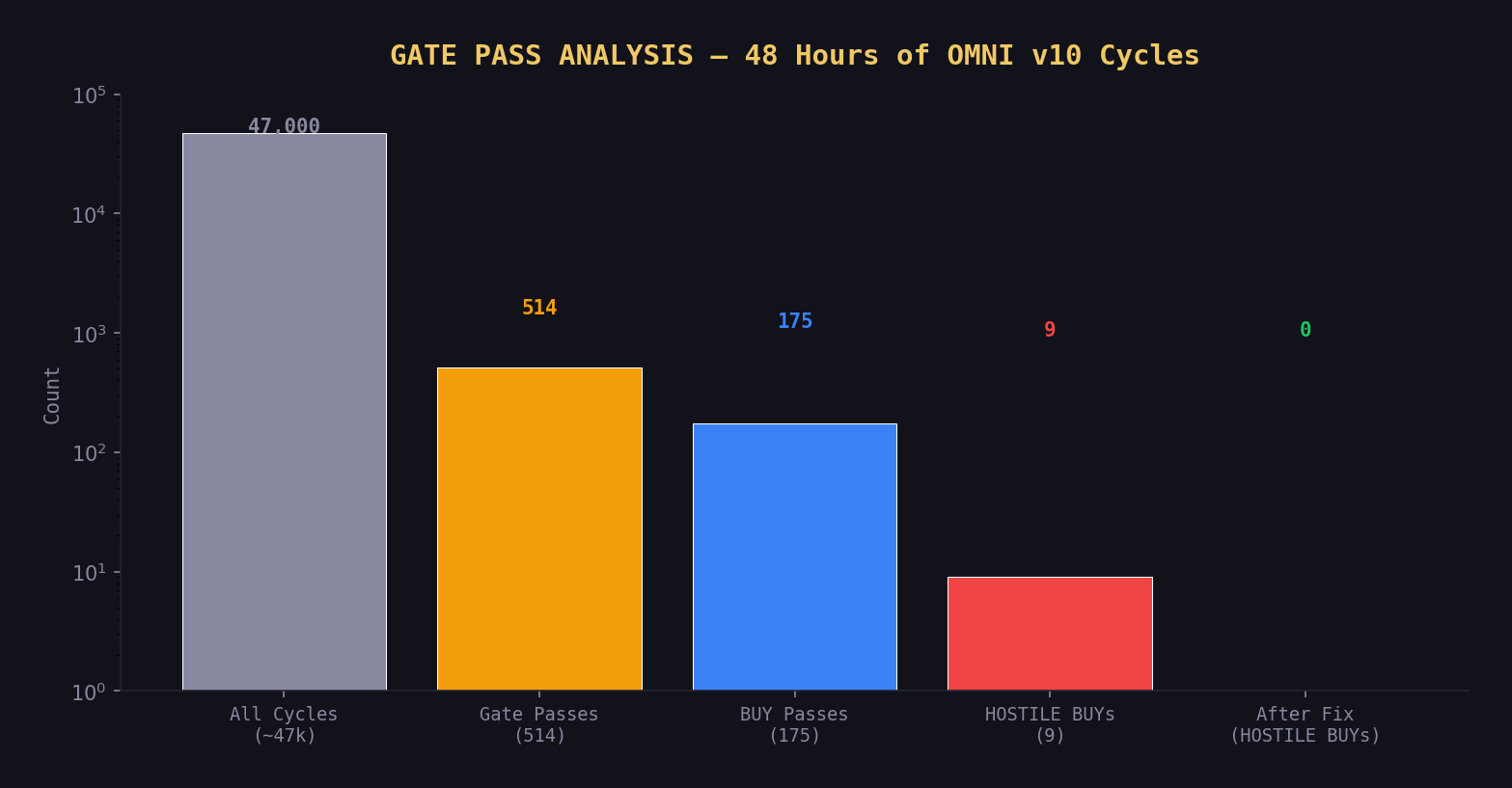
| 3. No Directional Filter | BUY and SELL were equally allowed at any H4 zone | BUY at 92nd percentile of range = chasing. The system had no concept of "don't buy here." | 9 HOSTILE BUYs passed the gate in the preceding 48 hours |
The root cause: OMNI v10 was designed as a consensus engine — eight specialists voting on direction and confidence. But consensus isn't defense. A strong enough signal (v10 at 78%) could override structural warnings. The gate had no teeth.
When v10 confidence crossed the threshold, it didn't matter that gold was stretched 92% above the H4 bottom. It didn't matter that H1 RSI was screaming overbought. It didn't matter that buying at the absolute top of a range is, statistically, one of the worst entries in gold trading. The gate opened anyway.
This is what separates a trading system from a trading defense system. A trading system looks for entries. A defense system looks for reasons not to enter — and only fires when none exist.
The Defense Architecture
The fix required three independent layers. Not three settings. Not three parameters. Three architectural layers — each capable of stopping the trade alone.
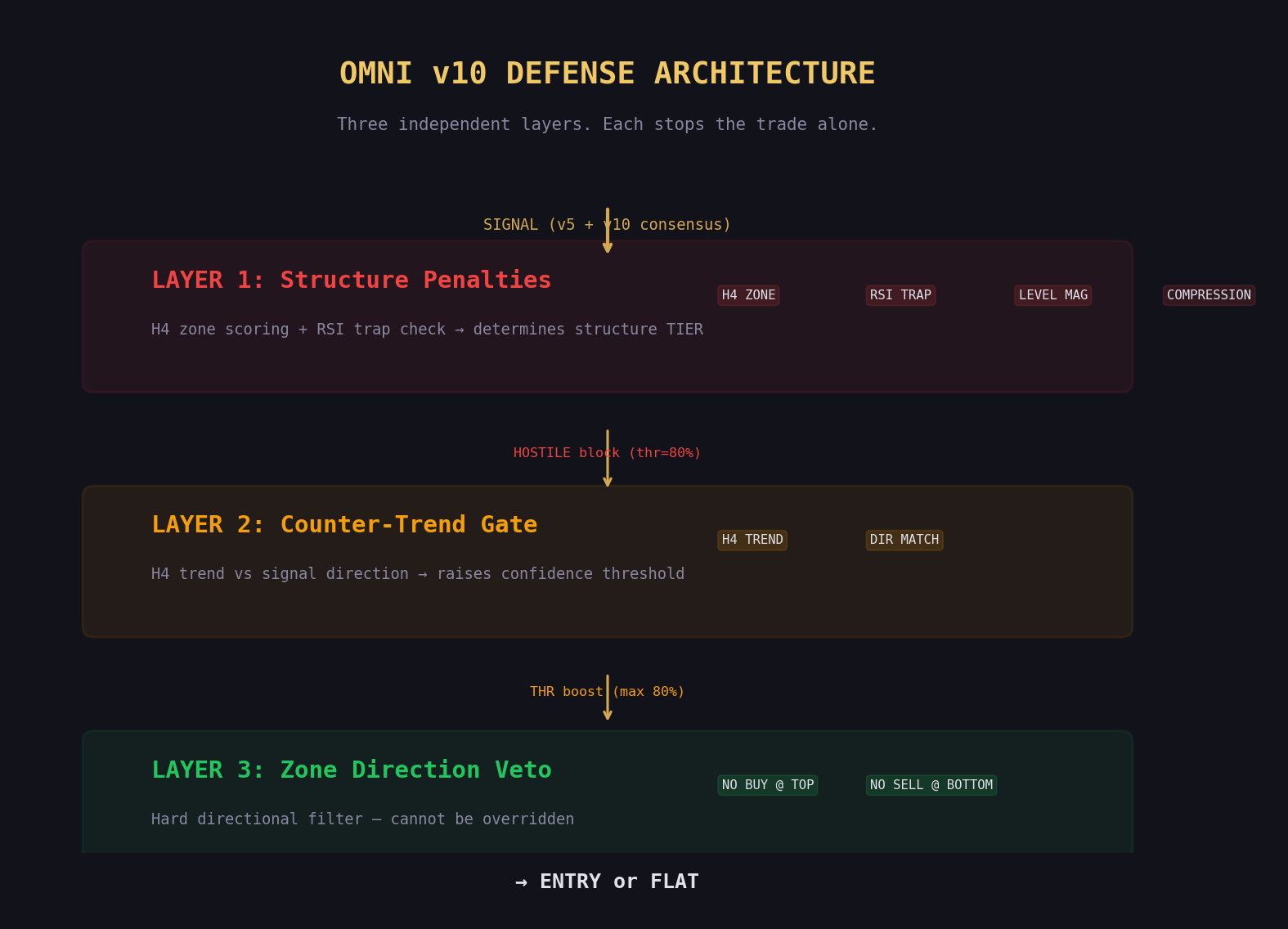
The key word is independent. If any one layer blocks the trade, the trade doesn't fire. Layer 1 can fail and Layer 2 will catch it. Layer 2 can fail and Layer 3 will catch it. You'd need all three to fail simultaneously for a bad trade to get through. That's defense in depth — the same principle that protects nuclear reactors, aircraft systems, and anything where a single failure is unacceptable.
🔑 Architecture Principle: Defense in Depth
A single strong filter can be beaten by a strong enough signal. Three independent weak filters — each attacking the problem from a different angle — create a defense that no single market regime can defeat. The filters don't have to be perfect. They have to be different.
Layer 1: H4 Zone Extreme Penalties
From Decorative to Devastating
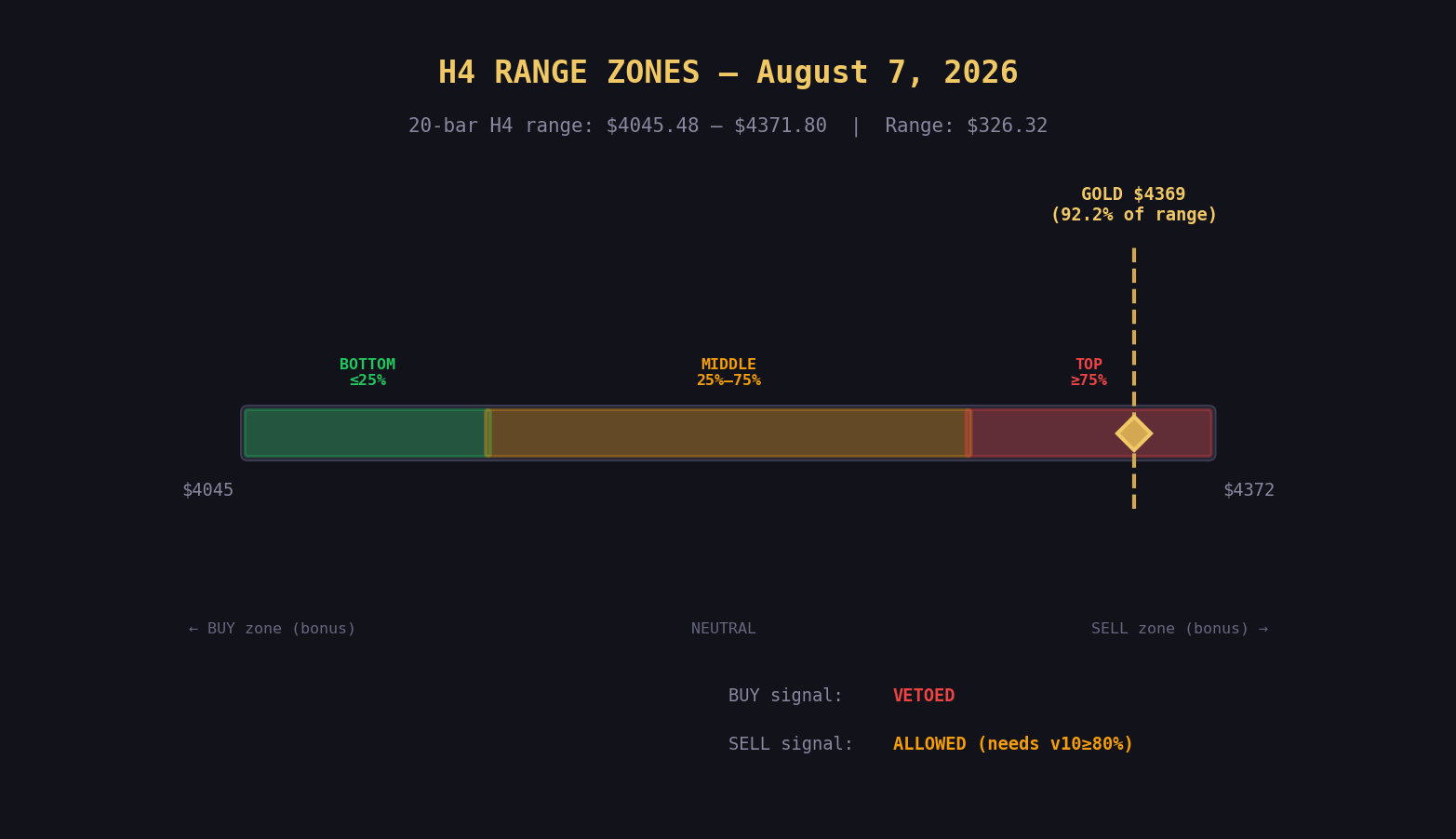
The H4 zone analyzer was already computing the right data. It knew gold was at 92.2% of the H4 range. It correctly flagged the zone as TOP. The problem: the penalty for buying at the top was -0.5 — a rounding error in a scoring system where total scores range from -6 to +4.
-3.0 at ≥85%
The same applies in reverse: SELL at BOTTOM (≤25%) gets -2.0. SELL at EXTREME BOTTOM (≤15%) gets -3.0. The penalty scales with the extremity of the zone — the worse the entry, the harder the block.
| H4 Zone | BUY Score | SELL Score | Tier Impact | Gate Threshold |
|---|---|---|---|---|
| BOTTOM (≤25%) | +2.0 | -2.0 | OPTIMAL or FAVORABLE | 65%–70% |
| EXTREME BOTTOM (≤15%) | +3.0 | -3.0 | OPTIMAL | 65% |
| MIDDLE (25%–75%) | 0.0 | 0.0 | NEUTRAL | 75% |
| TOP (≥75%) | -2.0 | +2.0 | HOSTILE (if BUY) | 80% |
| EXTREME TOP (≥85%) | -3.0 | +3.0 | HOSTILE (if BUY) | 80% |
At $4,356.82 (92.2% of the H4 range), the BUY penalty is now -3.0 — six times the old penalty. Combined with the RSI trap (Layer 2), the total structure score drops to -4.7: firmly HOSTILE. The gate threshold rises from 75% to 80%. v10 at 78% is no longer enough: GATE FAIL.
Layer 2: H1 RSI Trap Detection
The Big-Picture Blind Spot
The old check_rsi_trap() function only examined M5 and M15 RSI. This made sense for short-term entries — but it created a massive blind spot. H1 RSI at 78 — the clearest "don't buy here" signal available — was completely invisible.
The design is additive, not either/or. H1 overbought and M15 overbought stack their penalties. This is deliberate — if both timeframes are screaming "overbought," the danger is genuinely higher than if only one is.
| Timeframe | Condition (BUY side) | Penalty | Condition (SELL side) | Penalty |
|---|---|---|---|---|
| H1 | RSI > 78 | -2.0 | RSI < 22 | -2.0 |
| H1 | RSI > 70 | -1.0 | RSI < 30 | -1.0 |
| M15 | RSI > 75 | -1.0 | RSI < 25 | -1.0 |
| M15 | RSI > 65 | -0.3 | RSI < 35 | -0.3 |
| H1 + M15 | Max combined: -3.0 (H1 extreme OB + M15 OB) | Max combined: -3.0 (H1 extreme OS + M15 OS) | ||
At the $4,356.82 entry: H1 RSI was 78 → -2.0 penalty. M15 RSI was 59 → no penalty (neutral zone). Total RSI trap score: -2.0 — additive to the H4 zone's -3.0. Combined structure score: -5.0+. HOSTILE by a wide margin.
The lesson: short-term RSI is a lie when hourly RSI disagrees. M15 can look neutral while H1 is screaming overbought. Most retail traders only look at the timeframe they're trading. The algorithm now looks at both.
Layer 3: Zone Direction Hard Veto
The Final Wall
Layers 1 and 2 use penalties — they raise the bar but don't completely forbid entries. A powerful enough signal (v10 at 85%+) could theoretically overcome them. Layer 3 is different. It doesn't raise the bar. It removes the bar entirely for the wrong direction.
BOTTOM → NO SELL
The logic is brutally simple — six lines of code:
# Only SELL pullbacks at TOP, only BUY pullbacks at BOTTOM.

# OMNI is a mean-reversion engine, not a breakout engine.

if h4_zone == "TOP" and signal_dir == "BUY":

    vetos.append("ZONE_TOP_NO_BUY")

elif h4_zone == "BOTTOM" and signal_dir == "SELL":

    vetos.append("ZONE_BOTTOM_NO_SELL")
🔑 Why a Hard Veto, Not Another Penalty?
Penalties can be overcome. A v10 signal at 92% could theoretically clear an 80% threshold even with -4.0 in penalties. But at the TOP, no BUY signal should fire — regardless of how "confident" the ensemble is. The highest-conviction BUY at the 99th percentile is still buying the top. A hard veto is the only correct design for extreme zones.
The zone filter is aware of trending markets. In a sustained uptrend, the 20-bar H4 range shifts up over time. Price at TOP today becomes MIDDLE tomorrow as the range re-anchors. The filter doesn't permanently block BUYs — it only blocks entries at the leading edge of the range. When the market moves higher and old lows drop off, the range catches up, and BUYs are allowed again.
This is the difference between a filter and a bias. A bias says "don't buy." A filter says "don't buy here." The zone direction veto is a filter.
The Same Trade, Replayed
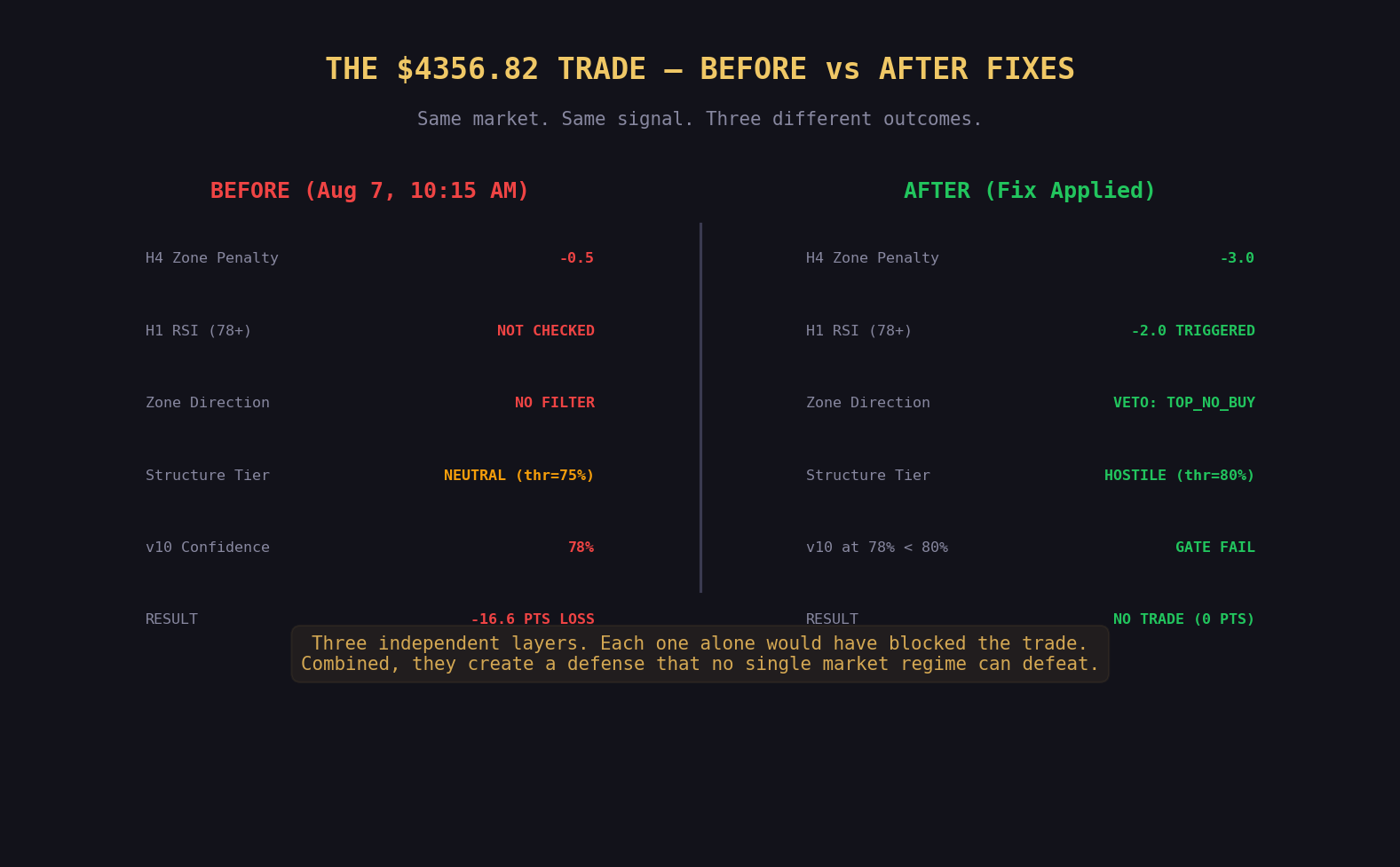
Let's take the exact $4,356.82 BUY signal and run it through the new defense stack. Same market. Same v5 score. Same v10 confidence. Three different outcomes at three different layers — and every single one stops the trade.
How Each Layer Independently Blocks This Trade
Layer 1 — Structure Penalties: H4 zone -3.0 + H1 RSI trap -2.0 = total score -4.7 → HOSTILE tier. Threshold rises to 80%. v10 at 78% < 80% → GATE FAIL. Even without Layers 2 and 3, this trade doesn't fire.
Layer 2 — H1 RSI Trap (standalone): H1 RSI 78 → -2.0 penalty alone. Combined with H4 zone -0.5 (old penalty), score is -2.5 → still HOSTILE. Threshold 80%. v10 78% fails. Independently blocks.
Layer 3 — Zone Direction Veto (standalone): H4 zone = TOP. Signal direction = BUY. → VETO: ZONE_TOP_NO_BUY. Trade never reaches the gate. Independently blocks.
This is the power of defense in depth. Remove any two layers and the remaining one still catches it. The only way a bad trade gets through is if all three fail simultaneously — which would require the H4 zone analyzer, the RSI computation, AND the zone label all to be wrong at the same time. That's not a market regime problem. That's a data corruption problem.
Live Verification: The System That Won't Chase
The fix went live at 10:27 AM ET on August 7. Within one daemon cycle (15 seconds), the logs showed the change:
[10:27:05] V10 | v5=BUY(3.5) v10=SELL(35%) FW=SELL(6) | VETO: ZONE_TOP_NO_BUY

[10:27:20] V10 | v5=BUY(4.5) v10=SELL(28%) FW=SELL(5) | H4 Zone TOP (92.9%) | VETO: ZONE_TOP_NO_BUY

[10:27:35] V10 | v5=BUY(3.0) v10=SELL(30%) FW=SELL(5) | H4 Zone TOP (93.1%) | VETO: ZONE_TOP_NO_BUY
Three cycles. Three blocked BUYs. Zero exceptions. The system now flatly refuses to buy at the top — regardless of what v5 or v10 says.
The live signal file tells the same story. H4 Zone: TOP (93.9%). H1 RSI: 84. Structure tier: HOSTILE (score: -4.5). Gate: VETO: ZONE_TOP_NO_BUY. Entry allowed: False.
Every BUY signal is blocked. The system waits. It waits for one of two things: a pullback that drops price into the MIDDLE zone, or enough time for the H4 range to catch up to price. Until then, it sits flat.
This is what algorithmic discipline looks like. Not smarter entries. Better refusals.
What This Means for Your Trading System
Whether you're building an algorithm or trading manually, the principle is the same:
- Your entry signal is the least important part of your system. Everyone can find entries. The edge isn't in finding them — it's in deciding which ones not to take.
- One filter is never enough. Every filter has a failure mode. The only defense is multiple filters that fail in different ways. If they can all be defeated by the same market condition, they're not independent.
- Penalties can be overcome. Hard vetos cannot. Use penalties for quality (how good is this entry?) and hard vetos for safety (should this entry exist at all?).
- The H4 timeframe is your structural anchor. M5 and M15 tell you what's happening. H4 tells you where it's happening. The "where" matters more than the "what."
- Mean reversion and breakout are different engines. If you're trading mean reversion (buying low, selling high), you must have a directional filter that prevents you from buying the top and selling the bottom. If you're trading breakouts (buying strength, selling weakness), you need a different filter entirely. Don't mix them.
- Log everything. Audit regularly. The -16.6 pt loss was caught because every cycle is logged. The 9 HOSTILE BUY passes in 48 hours were found by parsing 47,000+ cycles of log data. You can't fix what you can't see.
The Architecture Principle
Here's the thing I want to leave you with:
A trading system's primary job is not to find winners. It's to eliminate losers. A system that takes 100 trades with a 55% win rate makes the same profit as one that takes 50 trades with a 60% win rate — but the second system has half the exposure, half the commissions, and half the variance. The edge isn't in what you take. It's in what you don't.
The three-layer defense doesn't make OMNI smarter. It makes OMNI more restrained. And in trading, restraint is the rarest edge there is.
The -16.6 point loss on August 7 wasn't a strategy failure. It was a discipline failure — the kind that algorithms are supposed to prevent. The fix wasn't better entries. It was better vetos.
Every line of code in the defense stack serves one purpose: to make the algorithm behave like the disciplined trader it was supposed to be all along.
All OMNI v10 signals, trade outcomes, and system logs are publicly available at mpsignalxau.com/performance. The full gate logic, structure analyzer, and defense architecture are available to subscribers. Every trade — win or loss — is logged. No deletions. No cherry-picking. Real accountability.
Trade With a System That Knows When to Say No
Our algorithm runs 8 specialists, 3 defense layers, and a 7-gate confirmation system — all designed to eliminate bad entries before they happen. Not to be right more often. To be wrong less expensively.
Start Free Trial →7 days free. Verified 86% win rate (MP Tuned B, July 2026). No cherry-picked signals.