What the Chart Shows vs. What It Actually Means
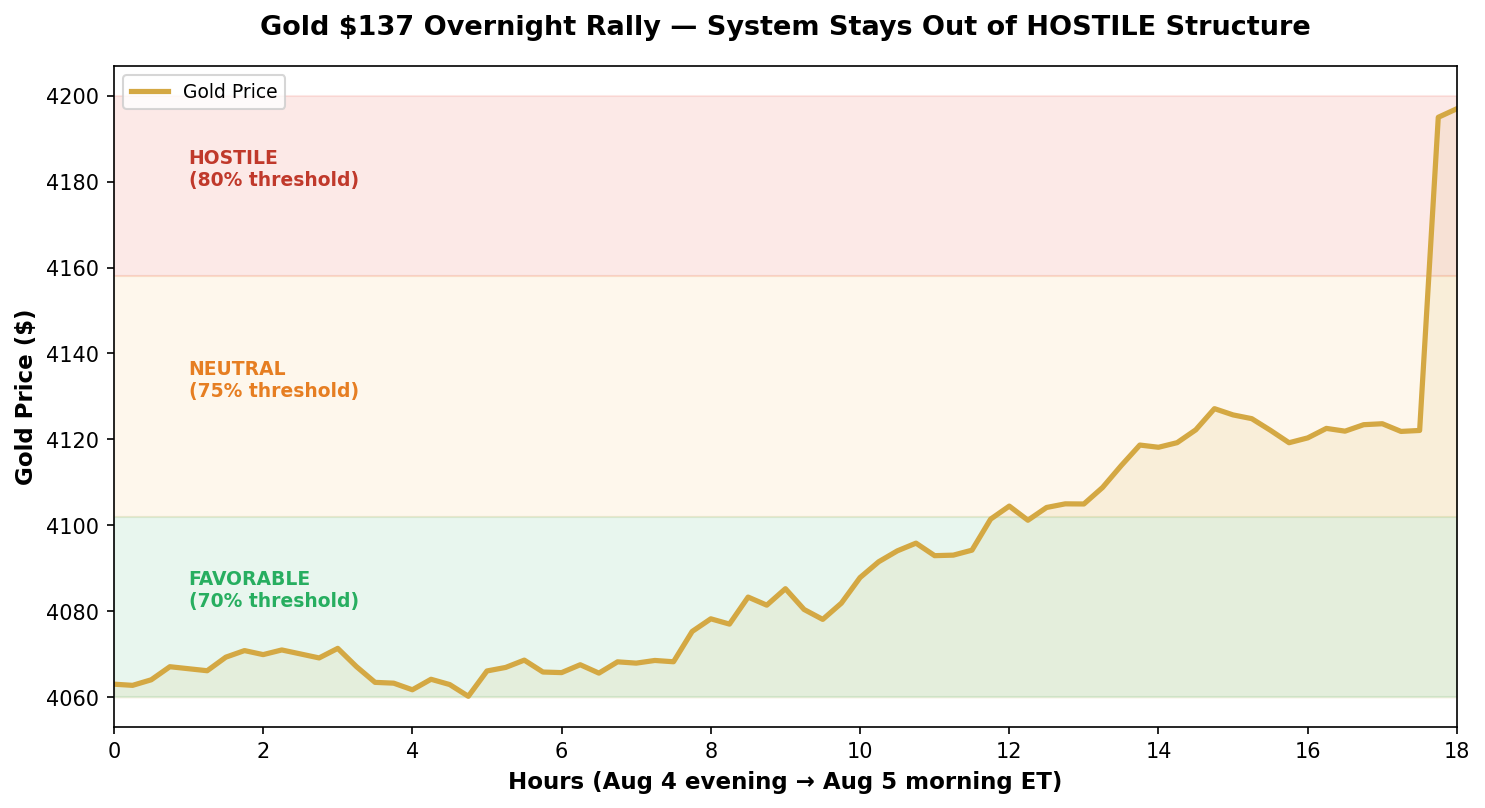
Here's what most traders see: a beautiful uptrend. Higher highs. Higher lows. Clean M15 structure. Volume confirming every leg up. The kind of move that makes you feel stupid for not being in it.
Here's what my system sees: HOSTILE structure.
These two perspectives aren't just different — they're opposed. And the gap between them is where accounts get destroyed.
The Multi-Timeframe Problem Nobody Talks About
Gold doesn't exist on one timeframe. It exists on all of them simultaneously. And what's true on M5 is often a lie on H4.
Right now, on M15 and H1, gold looks unstoppable. The trend is clean. Pullbacks are bought aggressively. Every dip finds a bid. This is what traders call "confirmation."
Now zoom out to H4:
| Timeframe | What It Shows | Signal |
|---|---|---|
| M5 | Strong bullish momentum, CHoCH flips everywhere | ✅ BUY |
| M15 | Clean uptrend, higher highs since $4,062 | ✅ BUY |
| H1 | In trend, but reaching upper Bollinger band, RSI > 70 | ⚠️ CAUTION |
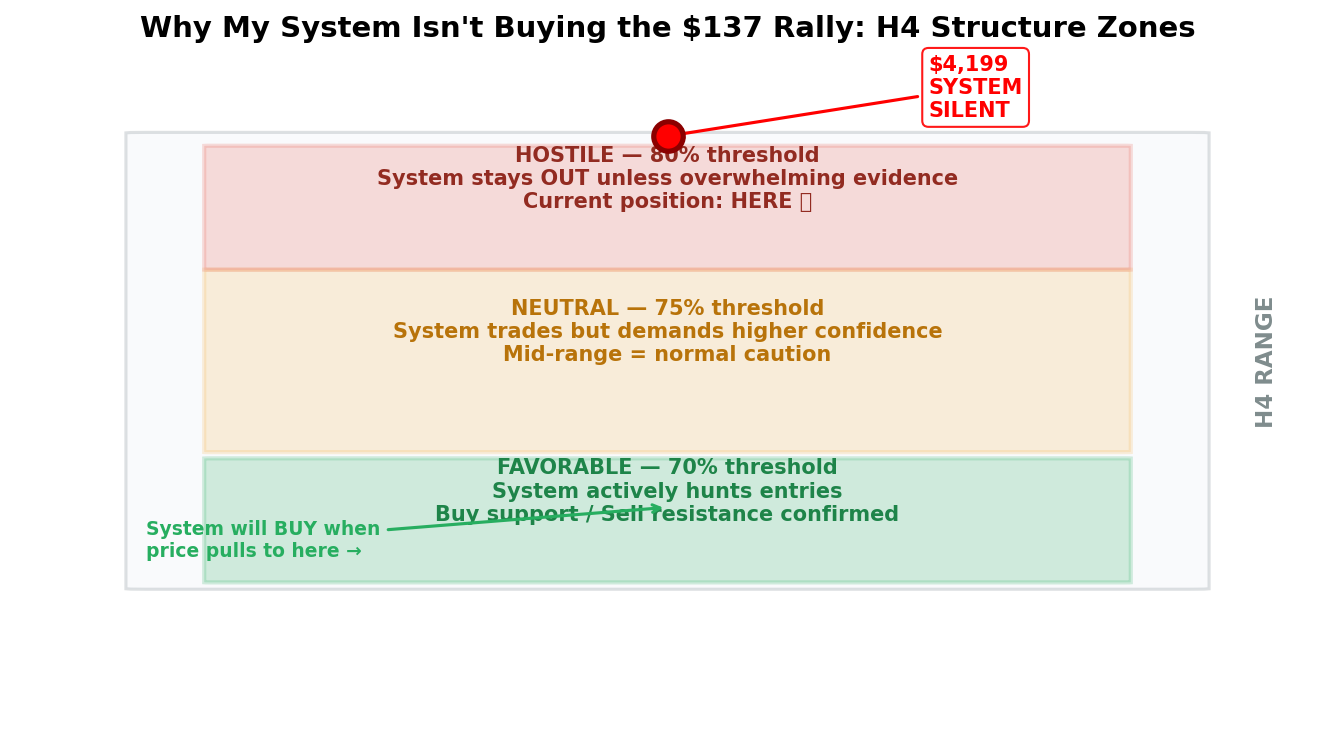
| H4 | Price is above the 85th percentile of the H4 range. Structurally stretched. | 🛑 HOSTILE |
M5 and M15 are screaming BUY. H4 is screaming DON'T. Most retail traders only see the first two. My system weights the last one the heaviest.
Here's why.
The FOMO Tax: What Buying Tops Actually Costs You
I have the data on this because I track every trade. Here's what happened the last two times my system bought into HOSTILE structure — before I fixed it:
August 4, BUY @ $4,167.63. Gold was near the top of the H4 range, structure was HOSTILE, the gate should have demanded 80% confidence. Instead, the old system let it through at 70%. Result: -8.47 points. Stop loss hit.
August 4, BUY @ $4,162.86. Same day, same HOSTILE structure. The system fired again. -6.03 points. Stop loss hit.
Two trades. -14.5 points. Both in HOSTILE structure. Both would have been blocked by the new structure-aware gate.
Now multiply that by every rally. Every top. Every "this time it's different." Over 35 trades, buying HOSTILE structure cost the system enough pips to turn a profitable strategy into a loser.
The single most expensive mistake in gold trading isn't getting the direction wrong. It's getting the direction right at the wrong structural level.
What the System Is Waiting For
Not buying doesn't mean sitting on your hands forever. It means waiting for one of three things to happen:
1. A pullback to FAVORABLE structure. If gold retraces $30–50 and finds support at a prior H4 swing level — say $4,130 or $4,100 — the structure flips from HOSTILE to NEUTRAL or FAVORABLE. The gate threshold drops from 80% to 70%. The same setup that would have been rejected at $4,199 gets a green light at $4,130.
2. Structure rebuilds higher. If gold consolidates between $4,180–$4,200 for 1–2 H4 candles, the H4 range recalibrates. What was "the top" becomes "the middle." Structure shifts from HOSTILE to NEUTRAL. The system doesn't need price to go down — it just needs the range to catch up to price.
3. Overwhelming confirmation. Even in HOSTILE structure, the gate CAN fire — but only with 80%+ v10 confidence. This requires the CHoCH, multi-TF alignment, RSI context, and momentum all screaming the same thing. It requires evidence so strong that the structural risk is worth taking. That evidence currently doesn't exist — v10 is at 28% and pointing in no clear direction.
Why This Is So Hard to Do (And Why It Matters)
I'm going to be honest: watching a $137 rally from the sidelines feels terrible.
Every green candle feels like money you're leaving on the table. Your brain runs the calculation automatically: "$137 move × X lots = $Y in profit I missed." The regret is physical. It's cortisol. It's the same neurochemical mechanism that makes gambling addictive.
This is precisely why algorithmic trading exists. The algorithm doesn't feel regret. It doesn't see a $137 rally and think "I missed it." It sees HOSTILE structure and thinks "not yet." It doesn't care what happened yesterday or what might happen tomorrow. It cares about what the data says right now.
The human trader who bought this rally at $4,100 is up $99 right now. They feel like a genius. They'll probably tell their trading group about it. They might even post a screenshot.
The algorithm that sat out the rally has zero profit. Zero loss. Zero emotional damage. And when gold pulls back $40 — which it will, because it always does — the algorithm will be ready with clear eyes and dry powder. The human trader will be in drawdown, hoping it "comes back."
One of them will still be trading in six months. The other will be looking for a new strategy.
The Real Edge in Gold Trading
Everyone thinks the edge is in knowing when to enter. It's not. The edge is in knowing when NOT to enter.
A system that takes 10 trades a day and wins 6 is a 60% win rate — but it's exhausting, expensive in spreads and commissions, and prone to overtrading during bad regimes.
A system that takes 3 trades a day — the 3 best setups, filtered through structure, sessions, and multi-timeframe alignment — might win 2 of them. Same win rate. But the 7 trades it didn't take? Those are the ones that would have been coin flips, FOMO entries, and structural traps. The filtering IS the edge.
Right now, my system is filtering. It's not broken. It's not "missing the rally." It's doing exactly what it was rebuilt to do: stay out of bad structure and wait for good structure.
The rally will either pull back or consolidate. When it does, the system fires. Until then, silence.
That silence is worth more than any trade I could take right now.
Live signals and full trade transparency at mpsignalxau.com. Every trade logged. Every structure analysis visible. No hidden filters. No deleted losses.
Trade With a System That's Already Done the Testing
Our algorithm tests every signal against 7 gates — regime, timeframe, session, volume, risk, calendar, and trend alignment. No indicator worship. No myth-based entries. Just data-driven execution.
Start Free Trial →7 days free. Peak win rate: 87.5% (verified July 30, 2026).